OxyPRAS Plus® BBE/KVL Bi-Plate
Price
$3.06 – $30.53
Product Options:
B-BCD-10 – (10 plates per pack) – $29.64 per pack
Additional information
Product Information
OxyPRAS Plus® BBE/KVL Bi-Plate
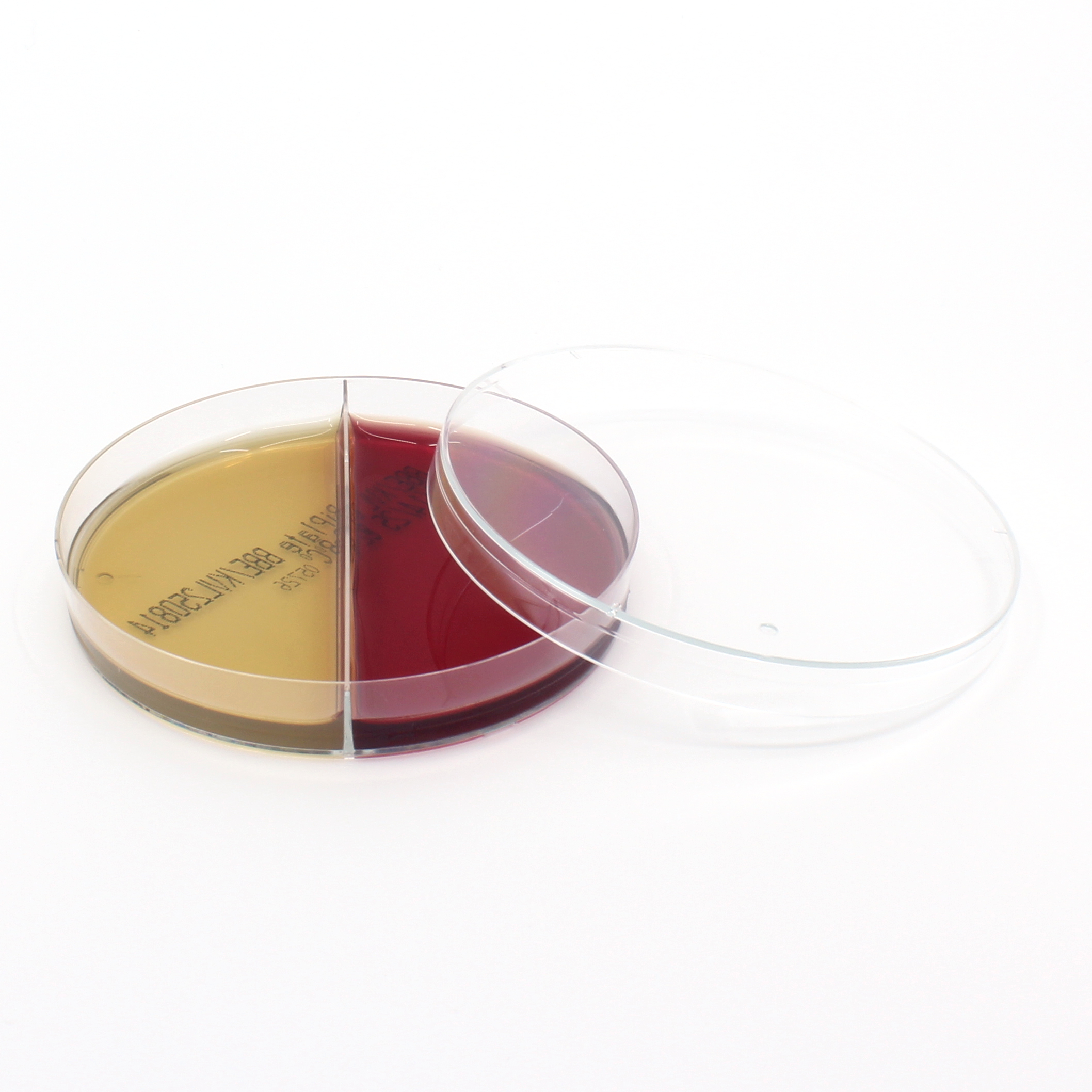
The OxyPRAS Plus® BBE/KVL Bi-Plate is a pre-reduced anaerobically sterilized (PRAS) divided plate that carries two selective anaerobic media. The BBE side is Bacteroides bile esculin agar for selective isolation and presumptive identification of the Bacteroides fragilis group. The KVL side is kanamycin vancomycin laked blood agar for selective isolation of gram-negative anaerobes, including Prevotella, Porphyromonas, and Fusobacterium. One plate, one jar position, both selective reads. It arrives ready to inoculate with no post-reduction step.
At a glance
Catalog number: B-BCD-KV (single bi-plate), B-BCD-10 (10-pack). Also in multi-packs M-BBK-2 and M-BKBP-3.
BBE side: Beef extract and gelatin base, oxbile, esculin, ferric ammonium citrate, gentamicin, hemin 10 mg/L, vitamin K1 1 mg/L.
KVL side: Tryptic soy base, 5% laked sheep blood, hemin 5 mg/L, vitamin K1 1 mg/L, kanamycin, vancomycin.
Type: Selective and differential (BBE) plus selective (KVL).
Shelf life: 4 months from manufacture. 28-day minimum guaranteed on arrival.
Storage: 2 to 8°C. Ships at room temperature.
Packaging: Individually sealed oxygen-impermeable pouch.
User QC: Lot QC performed by Oxyrase to CLSI M22-A3.
Regulatory: For in vitro diagnostic use. Manufactured in Mansfield, Ohio under ISO 9001:2015.
When to use it
The bi-plate exists for labs that want the standard three-plate anaerobic setup (non-selective, gram-negative selective, B. fragilis group differential) without a third plate in the jar. Brucella plus the bi-plate covers the same ground as Brucella plus KVL plus BBE at two-thirds the plate count, jar space, and per-specimen media cost. It also simplifies bench protocols: every anaerobic specimen gets the same two plates, and the tech reads the BBE half for the black esculin reaction and the KVL half for pigmented and non-pigmented gram-negative colonies.
The trade-off is surface area. Each half has less streaking room than a full plate, so for specimens where you expect a high organism load or want to work up many colony types, the individual OxyPRAS Plus® BBE and KVL plates give more room. The OxyPRAS Plus® 2-Pack (Brucella plus bi-plate) and 3-pack (Brucella, PEA plus bi-plate) are packaged for the bi-plate workflow.
Why PRAS manufacturing matters
Anaerobic media that is poured and packaged in air accumulates oxidation products before it ever reaches your bench. Those products inhibit the most oxygen-sensitive anaerobes, and the effect is invisible: the plate looks fine and simply reports no growth.
OxyPRAS Plus® plates are reduced with the Oxyrase® Enzyme System before sterilization and held in a reduced state through storage and use. In our PRAS vs. non-PRAS comparison, 8 of 30 non-PRAS Brucella plates inoculated with Porphyromonas levii grew nothing at all, while 0 of 30 OxyPRAS Plus® plates failed. OxyPRAS Plus® plates also tolerate up to 2 hours of ambient oxygen exposure during setup without inhibitory oxidation, which gives the bench flexibility to batch work and to use automated streaking platforms.
Read the full data in The Plate That Reports Nothing and the oxygen exposure white paper.
Formulation
Approximate composition per liter of deionized water. Initial pH BBE side 7.5 (+0.2 / -0.3); KVL side 7.5 ± 0.3. Production lots may be adjusted to offset raw material variance in order to meet performance criteria.
| Component | Amount |
| BBE side: beef extract | 11.0 g |
| BBE side: enzymatic digest of gelatin | 34.5 g |
| BBE side: oxbile | 2.0 g |
| BBE side: esculin | 1.0 g |
| BBE side: ferric ammonium citrate | 0.5 g |
| BBE side: agar | 15.0 g |
| BBE side: hemin | 10.0 mg |
| BBE side: vitamin K1 | 1.0 mg |
| BBE side: gentamicin | 2.0 mL |
| KVL side: enzymatic digest of casein | 15.0 g |
| KVL side: enzymatic digest of animal tissue | 5.0 g |
| KVL side: yeast extract | 5.0 g |
| KVL side: sodium chloride | 5.0 g |
| KVL side: L-cysteine | 0.58 g |
| KVL side: agar | 15.0 g |
| KVL side: hemin | 5.0 mg |
| KVL side: vitamin K1 | 1.0 mg |
| KVL side: vancomycin | 1.1 mL |
| KVL side: kanamycin | 3.82 mL |
| KVL side: laked sheep blood | 51.0 mL |
| Both sides: sodium bisulfite | 0.1 g |
| Both sides: Oxyrase® Enzyme System | proprietary |
On the BBE side, oxbile and gentamicin inhibit most facultatives and bile-sensitive anaerobes while esculin hydrolysis blackens the medium around B. fragilis group colonies. On the KVL side, kanamycin and vancomycin select for gram-negative anaerobes and laked blood brings out Prevotella pigmentation early.
Quality control
Samples of every lot are tested to Oxyrase specifications incorporating CLSI M22-A3. The following results are confirmed before release:
| Organism | ATCC | Expected result |
| BBE side: Bacteroides fragilis | 25285 | Growth; black colonies in 2 to 3 days |
| BBE side: Prevotella melaninogenica | 25845 | No growth in 2 to 3 days |
| BBE side: Escherichia coli | 25922 | No growth in 2 to 3 days |
| KVL side: Bacteroides fragilis | 25285 | Growth in 2 to 3 days |
| KVL side: Clostridium perfringens | 13124 | No growth in 2 to 3 days |
| KVL side: Prevotella melaninogenica | 25845 | Growth in 2 to 3 days |
| KVL side: Staphylococcus aureus | 25923 | No growth in 2 to 3 days |
| KVL side: Escherichia coli | 25922 | Growth inhibited in 2 to 3 days |
Uninoculated BBE medium is pale yellow and uninoculated KVL medium is bright red, both with no surface imperfections. Each laboratory should establish its own QC program in line with its accreditation requirements; the organisms above are recommended for user QC.
Directions for use
- Allow plates to reach room temperature before use.
- Remove the plate from the pouch.
- Check for contamination, oxidation or discoloration on either side, and the expiration date.
- Inoculate and streak using standard technique.
- Invert and incubate at 35 to 37°C in an anaerobic bag, jar, or chamber.
- Include an anaerobic indicator such as OxyBlue™ to confirm anaerobiosis.
- Read plates after 2 to 3 days.
Anaerobic incubation is still required. PRAS manufacturing protects the medium before and during setup; it does not replace the anaerobic atmosphere during incubation.
Storage, shelf life and guarantee
Plates ship at room temperature and should be stored at 2 to 8°C on receipt. Expiration is 4 months from date of manufacture; the actual date is printed on each plate. Oxyrase guarantees at least 28 days of shelf life from the ship date, and longer dating can be arranged when you order. If OxyPRAS Plus® BBE/KVL Bi-Plates arrive short-dated, contaminated, or oxidized, or fail when used as directed, we refund the purchase price. Contact us with the lot number printed on the plate.
Limitations
- Both sides are selective and support only select organisms. Colony types require additional identification.
- B. vulgatus and B. ovatus may not hydrolyze esculin.
- Other organisms that can grow on the BBE side include Fusobacterium mortiferum, F. varium, gentamicin-resistant Enterobacteriaceae, enterococci, pseudomonads, staphylococci, and yeast.
- Each side has roughly half the streaking area of a full plate.
- The Oxyrase® Enzyme System contains a penicillin-binding protein that may interfere with penicillin and some related antibiotics. Do not use these plates for susceptibility testing.
- Contains material of animal origin. Source animals are documented free of BSE/TSE.
Frequently asked questions
Which side is which?
BBE is the pale yellow side (no blood). KVL is the bright red side (laked blood).
Can I run the bi-plate without a Brucella plate?
Not as a complete anaerobic culture. Both halves are selective, so gram-positive anaerobes such as clostridia and peptostreptococci will not be recovered. Always include a non-selective plate such as OxyPRAS Plus® Brucella.
Does one specimen streak cover both halves?
Inoculate each half separately from the specimen or primary inoculum and streak each side for isolation. Do not drag across the divider.
Do I need to reduce the plate before inoculating?
No. OxyPRAS Plus® plates are reduced during manufacturing and stay reduced in the sealed pouch. Open, inoculate, and incubate.
Does my lab have to run QC on each lot?
Each lot is tested by Oxyrase to CLSI M22-A3 before release. BBE and KVL are both on the M22-A3 exempt list; confirm your own program’s requirements for bi-plates.
Is it available through my distributor?
Yes, through Fisher Scientific and Cardinal Health, or direct from Oxyrase. Ask us about volume pricing for standing orders.