Media Specifications · Clinical Microbiology
PRAS tells you how a plate was made. ORP tells you what it will grow.
Oxyrase media now carries a specified oxidation-reduction potential on the plate label, and the measured value for your lot on the Certificate of Analysis.
The Gap
What PRAS tells you, and what it does not
PRAS (Pre-Reduced Anaerobically Sterilized) media is a useful and valuable guide to isolate and grow anaerobe microorganisms. However, we have learned that PRAS is not sufficient for growing all anaerobes.
PRAS describes how a medium was manufactured. It was reduced before it was sterilized, and it was handled without oxygen. What it does not tell you is how reduced the medium actually is. A plate can be accurately labeled PRAS and still sit at a potential that will not support the organism you are trying to recover.
For that, we need another measure. PRAS remains how Oxyrase media is made, and why that matters is covered here. What follows is the number that completes it.
The Measure
ORP, and what the number means
ORP (Oxidation-Reduction Potential) measures the oxidative-reductive state of the medium. It measures it in millivolts.
If the measure is +mV, the medium is in an oxidative state. If the measure is −mV, the medium is in a reductive state. As PRAS indicates, anaerobes require a reduced state to grow.
But it is possible to have a reduced-state PRAS medium, for example −100 mV, and still not grow some anaerobes. Reduced is not one condition. It is a range, and the organism decides where on that range it will grow.
The Range
Reduced is a scale, not a switch
Millivolts, drawn to scale. The rule marks the Oxyrase specification limit at −200 mV. Everything to the right of it meets specification. Anaerobe pathogens need the medium carried well past the point where it first turns negative.
Why It Matters
Where anaerobe pathogens actually grow
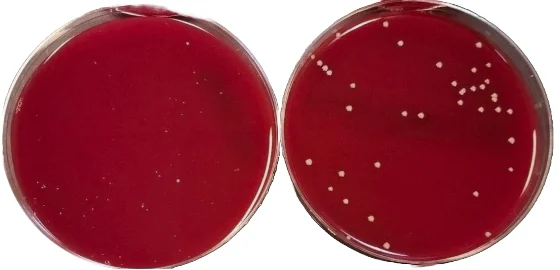
Anaerobe pathogens grow best in media with an ORP of −200 mV to −300 mV.
So it is not sufficient to designate a medium as PRAS for anaerobe pathogens. One must also identify the ORP of the medium to assure it will support their growth.
A PRAS designation and a measured potential answer two different questions. Only the second one tells you what the plate will do at the bench. If you are weighing formats rather than potentials, our anaerobic blood agar comparison sets the media types side by side.
The Specification
What Oxyrase now guarantees
Henceforth, Oxyrase, Inc. will designate the ORP of its media on the plate label.
ORP can only be measured after the media is made, so it is not possible to print the actual measurement on the plate being poured. We are therefore setting the specification as a limit: the ORP of Oxyrase media will be −200 mV or lower. More reduced is better, and it still meets specification. Less reduced does not.
On the plate label
The specification, printed on every plate, so the limit travels with the media.
On the Certificate of Analysis
The value that lot actually measured, so you can document what you received.
The Limit
Why not make everything −500 mV?
ORP extends to about −500 mV. One might ask why not make all media −500 mV. There are three reasons we do not.
Every millivolt is bought
The lower the ORP, the more stringent the means of reaching that measure becomes, and with it cost increases. That cost reaches the laboratory.
The agents that get you there
Some reducing agents capable of driving a medium that low are themselves inhibitory at the concentrations required. A plate can be pushed far enough to suppress the very organisms it was made to recover.
Past the clinical range
Anaerobe pathogens are recovered between −200 and −300 mV. Below that, the added stringency is spent on organisms a clinical laboratory is not culturing.
The Far End
The most demanding anaerobes
The most demanding anaerobes, the ones that need the medium carried well below −200 mV, are the methanogens. Some will not grow above −300 mV at all. These microorganisms represent one of the most ancient forms of life on earth.
They are not what a clinical laboratory is culturing. But they mark the far end of the scale, and they make the point plainly: the difference between one negative number and another is the difference between growth and nothing at all.
Questions
What the ORP designation changes
Does this change the media I already order?
No. The formulation is unchanged. What changes is that the redox state of the media is specified on the label, and measured and reported for every lot.
Why is the specification a limit instead of a number?
ORP can only be measured after the media is made, so the value for a lot does not exist at the time the plate is poured. The label carries the limit the lot must meet. The Certificate of Analysis carries what it actually measured.
Where do I find the ORP for my lot?
On the Certificate of Analysis for that lot. Submit the catalog and lot number through Certificate of Analysis Retrieval, or email info@oxyrase.com.
Is PRAS still meaningful?
Yes. PRAS remains a useful and valuable guide, and Oxyrase media is still made that way. The point is that PRAS alone does not tell you the redox state you are receiving, and for anaerobe pathogens that state is what determines recovery.
How is ORP measured?
With a redox electrode read against a reference electrode, after the media is made and set. The value is recorded per lot and reported on the Certificate of Analysis.
Ask About Your Lot
We will send the measured value.
If you want the ORP for media already on your shelf, or you want to talk through what your laboratory’s recovery targets require, send us the catalog and lot number and we will go through it with you.
Oxyrase, Inc. · Mansfield, Ohio · info@oxyrase.com