Five Brucella agars, one strict anaerobe, and a very clear gradient in what came back.
Every anaerobic culture your lab sets up has a variable nobody writes down.
Not the specimen. Not the transport time, which most labs track carefully. Not the incubation conditions, which get validated and monitored and documented. The variable is how long anaerobic plates sit out in room air between the moment they leave their packaging and the moment they enter the anaerobic chamber, and in most workflows nobody has ever measured it.
We wanted to know what that stretch actually costs. So we ran a study designed to look exactly like a bad day on the bench: take five Brucella agars representing the full range of oxygen protection available to a clinical lab, leave them in ambient room air for up to three hours, then inoculate them with a strict anaerobe and see what grows.
The answer turned out to be less about whether a medium is “anaerobic” and more about what it is doing while the plate sits open.
How long can anaerobic plates sit out before it matters?
Ask a microbiologist how long their anaerobic plates spend in room air and you will usually get a shrug and a guess. The guess is almost always low, because the exposure is not one event. It is four or five small ones stacked end to end.
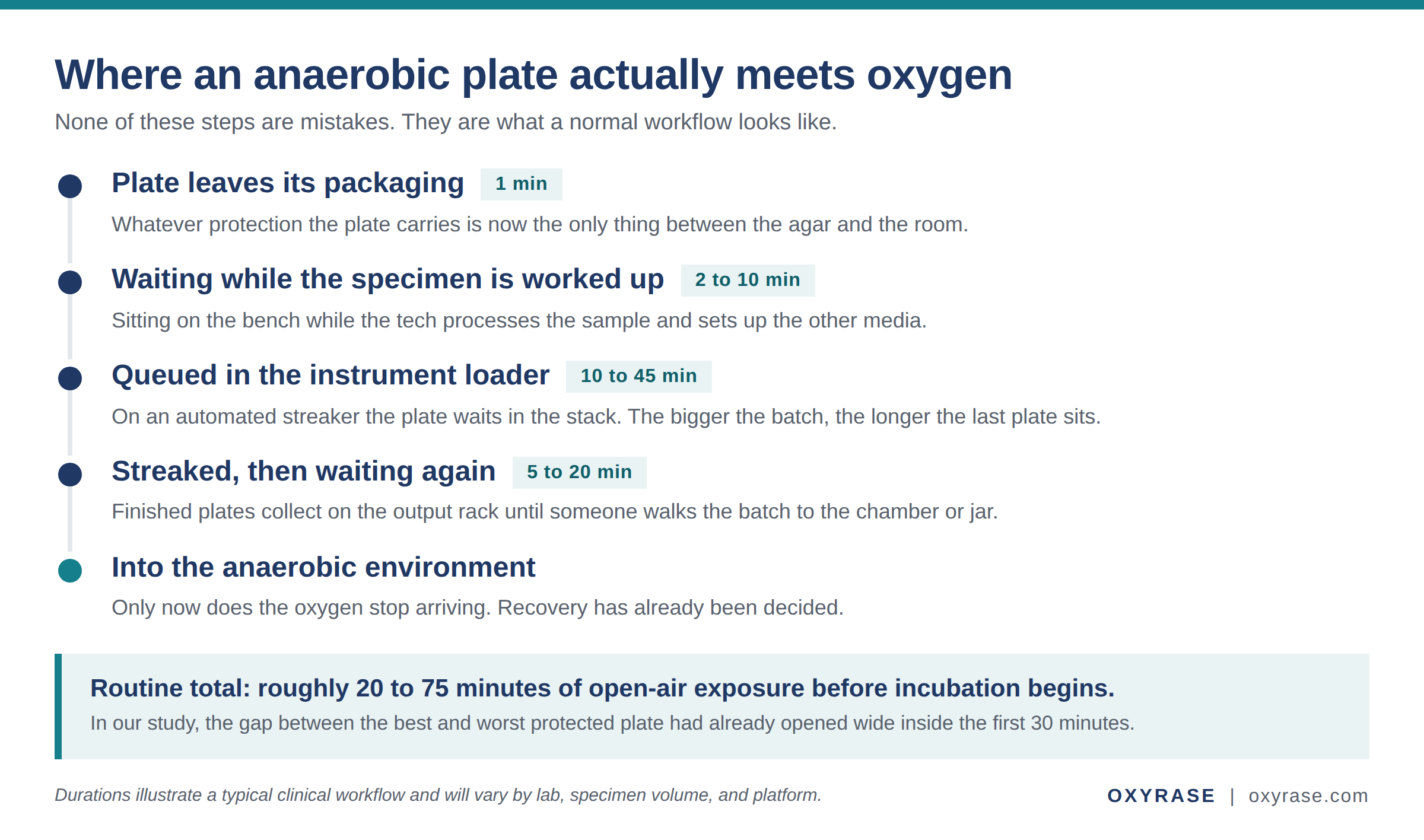
The plate comes out of its packaging. It waits while the tech works up the specimen and sets up the aerobic media. If the lab runs an automated streaker, the plate then waits again in the loader stack, and the last plate in a large batch waits considerably longer than the first. After streaking, finished plates collect on a rack until somebody walks the batch over to the chamber or seals the jar.
Add it up and a routine specimen can easily accumulate 20 to 75 minutes of open-air time before incubation ever begins. We wrote about how this plays out specifically on Copan and Kiestra platforms in Automated Microbiology Streaking: Navigating Anaerobic Bacteria, and the short version is that the problem gets worse the more you scale up.
The reason this matters is that agar is not inert during that window. It takes up oxygen from the air and oxidizes, and by the time an organism is deposited on the surface, the surface may no longer be the environment the medium was validated to provide. Oxygen is hostile to a strict anaerobe on several fronts at once, poisoning metabolic enzymes directly and generating reactive oxygen species, which Lu and Imlay review in detail in When anaerobes encounter oxygen in Nature Reviews Microbiology. An oxidized agar surface hands the organism that chemistry at the exact moment it is trying to establish.
What we actually tested
We compared five Brucella agar preparations, chosen because they span every route a lab has to lower the oxygen in a plate:
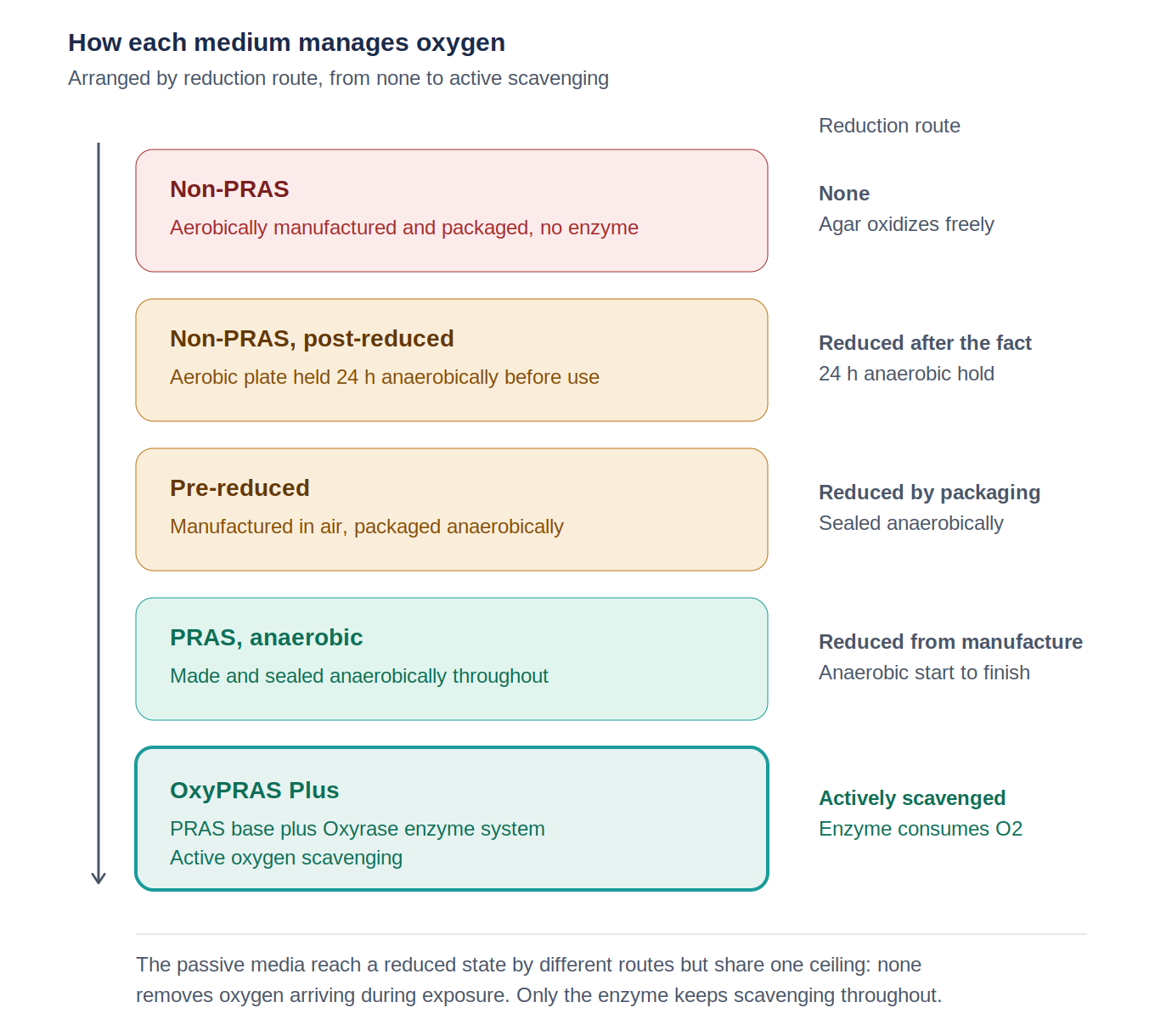
Non-PRAS agar is manufactured and packaged in air with no reduction at all. Post-reduced agar is that same aerobic plate held anaerobically for 24 hours before use. Pre-reduced agar is manufactured in air and then packaged anaerobically. PRAS agar is prepared, reduced, and sealed anaerobically from start to finish. OxyPRAS Plus is a PRAS base with the Oxyrase enzyme system incorporated, which consumes oxygen continuously rather than simply starting low. If the difference between those categories is fuzzy, we unpacked it in What is PRAS and Why Should Microbiologists Care About It?
Porphyromonas levii, a genuinely strict anaerobe, was standardized to a 2.0 McFarland suspension. Plates from each preparation were exposed to ambient benchtop air for 0, 30, 60, 120, or 180 minutes, then spread-plated, with four replicates per condition. Everything went into anaerobic incubation at 37 degrees C for 48 hours, and we counted colonies.
Reporting recovery against each medium’s own time-zero baseline was deliberate. These media do not start from the same place, and we did not want a medium that simply grows more organisms on a good day to look like a medium that resists oxygen well.
Recovery is a gradient, not a pass or fail
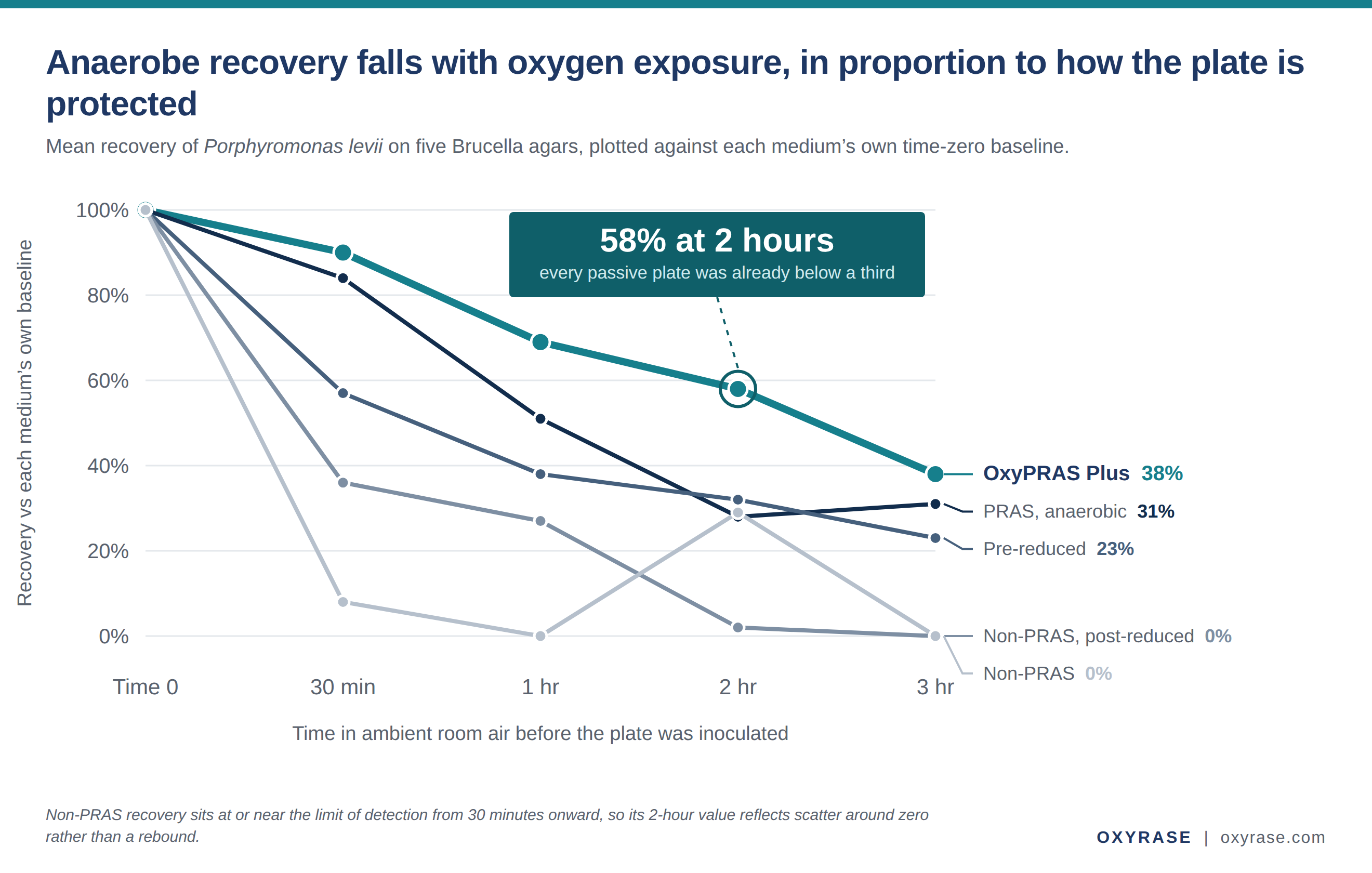
The result we did not expect was how orderly it was. Recovery lined up with oxygen protection at every single timepoint, in the same order, with no crossovers among the meaningful contenders.
| Exposure | Non-PRAS | Post-reduced | Pre-reduced | PRAS | OxyPRAS Plus |
|---|---|---|---|---|---|
| Time 0 | 100% | 100% | 100% | 100% | 100% |
| 30 minutes | 8% | 36% | 57% | 84% | 90% |
| 1 hour | 0% | 27% | 38% | 51% | 69% |
| 2 hours | 29%* | 2% | 32% | 28% | 58% |
| 3 hours | 0% | 0% | 23% | 31% | 38% |
* Non-PRAS recovery sits at or near the limit of detection from 30 minutes onward. Its 2-hour value comes from a mean of 2.8 CFU against a noisy 9.5 CFU baseline, so it reflects scatter around zero rather than a rebound.
At two hours, the plate with active oxygen scavenging still recovered 58% of its baseline. Every passively protected plate was below a third by that point, and the post-reduced plate had collapsed to 2%. At three hours the actively scavenged plate was still returning more than a third of baseline, while the two unprotected preparations were returning nothing at all.
There is a useful way to read this that has nothing to do with any particular product. The passive media differ enormously from each other, and a lab that assumes “reduced is reduced” is leaving real recovery on the bench. Post-reduced and pre-reduced plates are not interchangeable. Neither are pre-reduced and true PRAS. The gap between the worst and best passive option at 30 minutes was 8% versus 84%.
The first thirty minutes do most of the damage
If there is one number to take away, it is not the three-hour figure. It is the 30-minute one.
Half an hour is not an unusual delay. It is roughly how long anaerobic plates sit out on an ordinary run, well inside what a moderately busy micro bench produces without anyone doing anything wrong. And by 30 minutes the field had already spread across nearly the entire range it would ever occupy: 8% at the bottom, 90% at the top. The rest of the three hours mostly widened a gap that had already opened.
Which means the question this post opened with has a second half. How long a plate can sit out is worth measuring, but on its own it does not tell you much, because the answer depends entirely on what the plate is doing while it sits. And passive protection has a structural ceiling there. Pre-reduction, anaerobic packaging, and post-reduction all lower the oxygen a plate starts with. None of them remove oxygen that arrives after the seal is broken. An enzymatic system keeps consuming oxygen for as long as the plate is exposed, which is the only mechanism in this comparison that addresses the exposure window itself rather than the conditions before it.
What it looks like on the plate
Numbers understate this. The plates make it obvious.
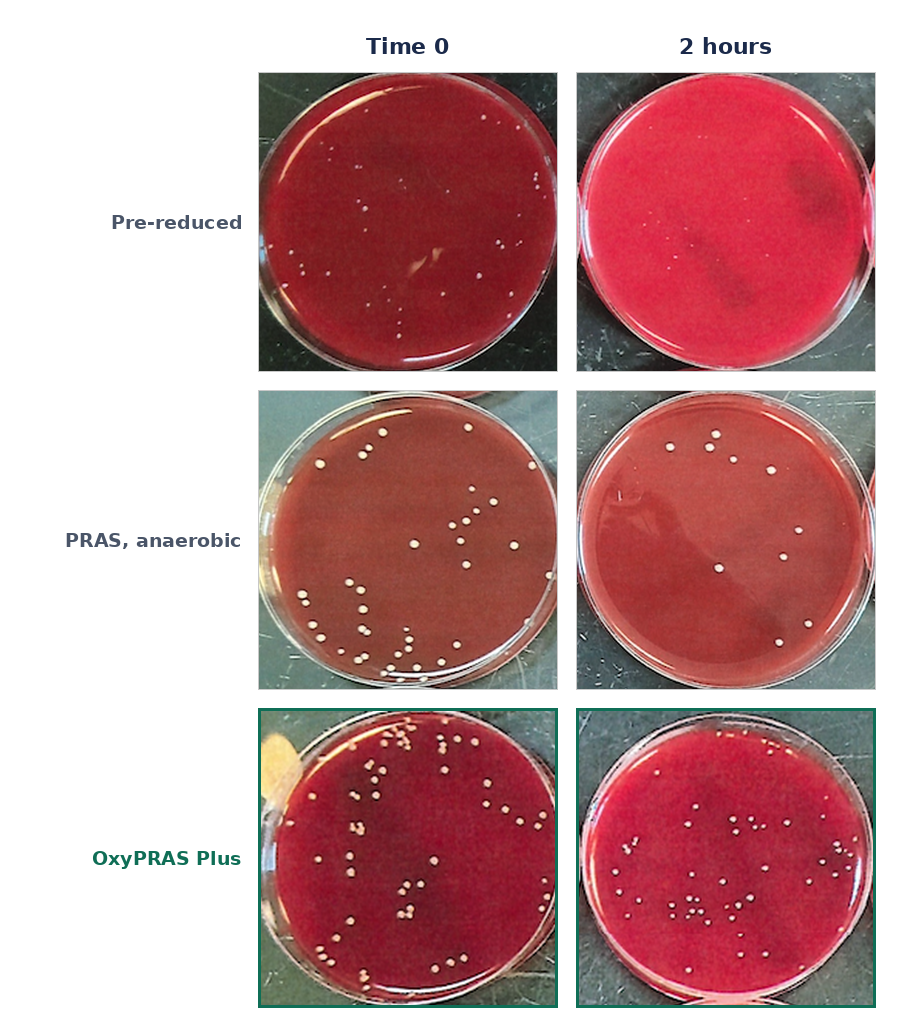
The pre-reduced plate at two hours is close to bare. The PRAS plate holds a scattering of colonies. The actively scavenged plate still shows a countable lawn. If a plate like the first one came off your bench, nothing about it would look like a failure. It would look like a negative culture.
That is the clinical version of this problem. A strict anaerobe that does not survive to form a colony does not show up as an error. It shows up as an absence, and absences do not get flagged.
Where we would push back on our own data
This was a single organism in a single laboratory. Porphyromonas levii is a reasonable stress test precisely because it is fragile, but a more aerotolerant anaerobe would show a flatter curve, and some would show almost no difference across these media at all. If your anaerobic workload is dominated by hardy organisms, the effect size here will overstate what you would see.
It is also worth naming the literature that appears to point the other way. In 1975, Tally and colleagues exposed 57 fresh clinical anaerobic isolates to room air and found that all of them tolerated eight hours or more, concluding that brief bench exposure would not be deleterious to anaerobes in clinical specimens. That study and this one are measuring different things. Tally exposed the organisms. We exposed the medium, then inoculated fresh organisms onto it. What we are describing is not oxygen killing bacteria in transit. It is an agar surface oxidizing into a state a strict anaerobe struggles to colonize, which is a separate failure mode and one that a hardy organism will mask. Loesche’s 1969 separation of strict from moderate anaerobes points the same way: Bacteroides fragilis shrugs off an hour in room air, and a genuinely strict organism does not.
Replicate counts were four per condition, which is enough to establish a clear direction and not enough to put tight confidence intervals on any single value. The Non-PRAS line, as noted, is essentially noise once it hits the floor. And we are the manufacturer of one of the media tested, which is a reason to read the methods rather than the summary. They are all in the paper.
What we would defend without hedging is the shape: recovery declines with exposure, the decline is steep early, and the ordering by protection level held at every timepoint we measured.
What to do with this
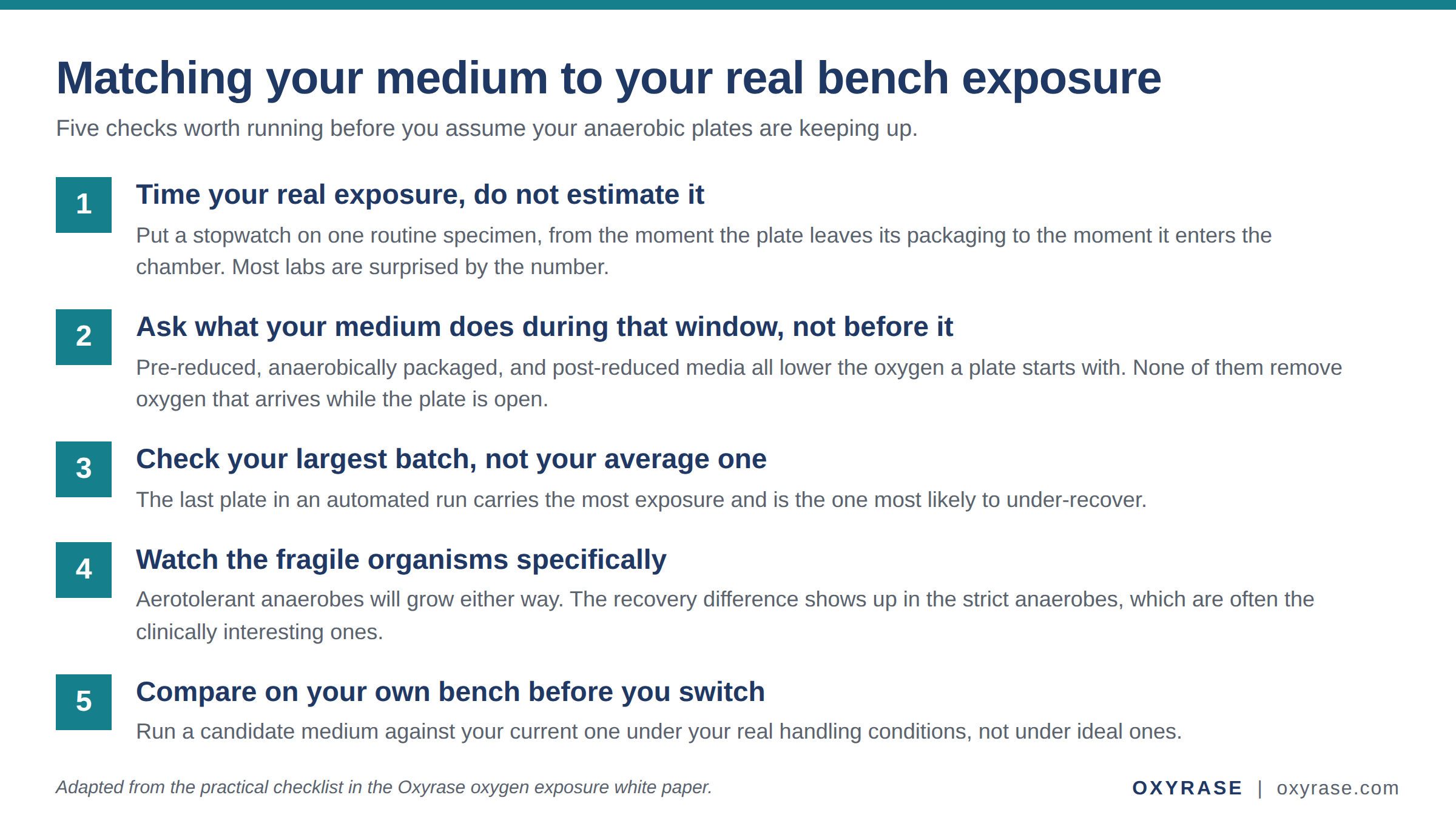
The most useful thing any lab can do with this study costs nothing: put a stopwatch on one routine anaerobic specimen, from the moment the plate leaves its packaging to the moment it enters the chamber. Most labs are surprised. Then look at where your medium’s protection actually applies, and ask whether it covers the window you just measured. CLSI M56 is the guideline that governs anaerobe detection in clinical specimens, and it is worth rereading with your own measured exposure time in hand.
If it does not, that is worth knowing before it shows up as a culture that came back negative when it should not have. How long anaerobic plates sit out is not a number most labs track. It is a number most labs could act on.
Get the full study
The complete white paper includes all CFU and survival data, the side-by-side plate images, full methods, the implications for automated streaking workflows, and the practical checklist above.